




Carbon cycle
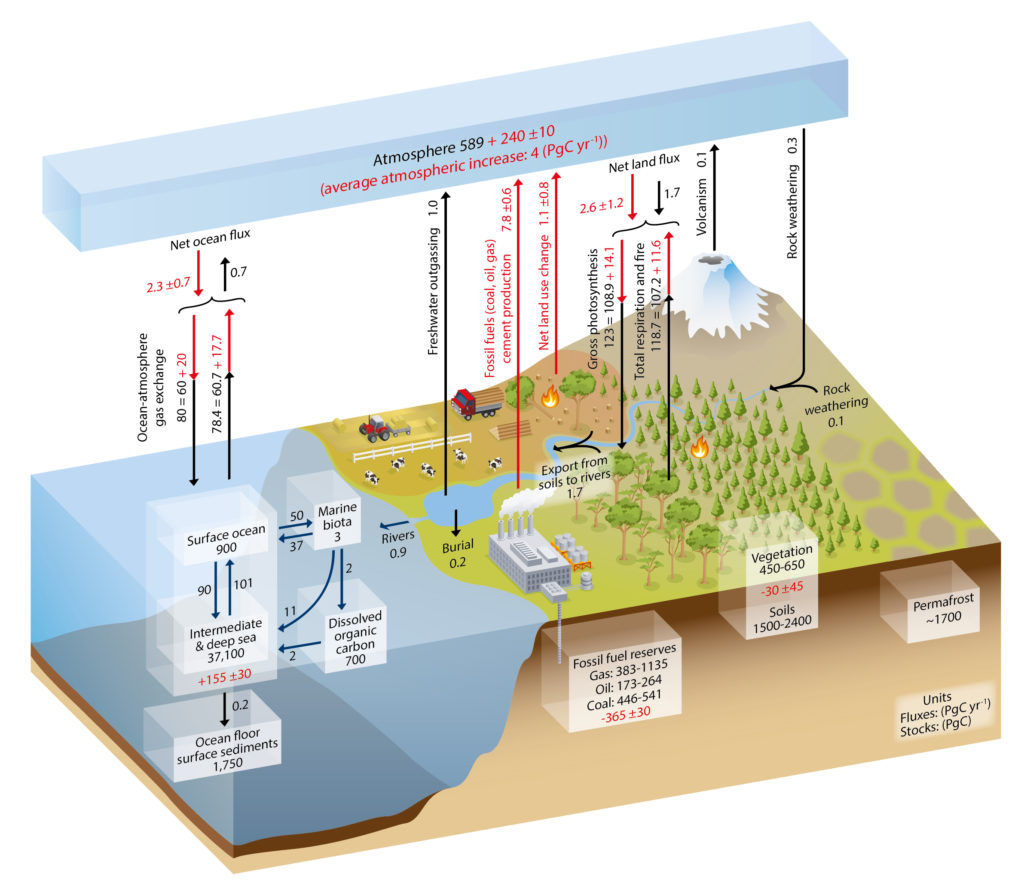
|
| IPCC Report AR5 Climate Change 2013: The Physical Science Basis, Chapter 6: Carbon and Other Biogeochemical Cycles fig 6.1 |
Contents |
Definition
AR5 Climate Change 2014: Impacts, Adaptation, and Vulnerability, Glossary, published by the Intergovernmental Panel on Climate Change (IPCC) defines the carbon cycle as: ‘...the flow of carbon (in various forms, e.g., as carbon dioxide) through the atmosphere, ocean, terrestrial and marine biosphere, and lithosphere.... the reference unit for the global carbon cycle is GtC or equivalently PgC (10^15g).’
Slow and fast domain carbon cycles
The IPCC distinguishes between slow carbon cycles of beyond 10,000 years, and those of 1–100 years and 10–500 years, known as fast carbon cycles.
Geological carbon cycles
The lithosphere carbon cycle, also known as the geological carbonate–silicate cycle is fully part of the slow carbon cycle and describes inert carbon in the lithosphere, much of which being the Earth's mantle from the beginnings of the Earth, with some from organic biosphere carbon. 80% is stored in limestone and in the calcium carbonate stored in the shells.
Oceanic carbon cycles
The oceanic or marine cycles cover both fast and slow cycles, with what is called the deep layer, a few hundred meters down, below the intermediate layer, this runs on carbon cycles over centuries or more, transferring carbon from the oceans to the floor of the ocean into sediments and the slow transfer to rock formations. The surface and intermediate layers of the oceanic cycle exchange carbon between marine biota, dissolved organic carbon (DOC) and dissolved in-organic carbon (DIC) over shorter cycles as well as between the ocean surface and the atmosphere on daily cycles.
Atmospheric carbon cycles
The atmospheric carbon cycle runs of fast cycles exchanging gaseous carbon compounds, primarily carbon dioxide (CO2), as well as methane (CH4), carbon monoxide (CO), and other man-made compounds between Earth's atmosphere, the oceans, and the terrestrial biosphere. Atmospheric concentrations of CO2 can remain stable over longer periods when a balance between flows exists. The burning of fossil fuels transfers carbon from the slow domain to the fast domain. Replenishment of carbon released from burning fossil fuels (and other terrestrial changes) through natural biogenic processes cannot occur quickly enough to rebalance the system, thus causing temperature rise.
Terrestrial biological carbon cycle
The terrestrial biological carbon cycle is the final and possibly most relevant cycle to human beings as this describes the fast domain cycle of carbon exchange relating to all land-living organisms both dead and alive, as well as in soils. This might also be referred to as the biogenic energy cycle as it refers to a system in balance between living things on Earth in the biosphere and its impacts on the atmosphere. It is also the result of changes in this balance caused by human activities resulting in imbalance in the system leading to temperature rise and climate change.
Related articles on Designing Buildings
Featured articles
Check out some of the best features and news from Designing Buildings as well as key stories from around the web.

Government approach could undermine delivery and regeneration.
World's first mass timber data centre.

The overlooked environmental aspect of data centre development.
Introduction to radon awareness

New technical information sheet published by CIOB.

Updated supplier guide can help electrical contractors engage with NHP.

CIAT confirm the winners of the 2026 architectural technology awards.

Government launches a one stop shop for flood preparedness.

Sir Edwin Lutyens: Britain's greatest architect? Book review.

CIOB publishes free template to help assess and manage risks.
ECA's reflections on Party Conference season

Burnham wants to be confident of winning before asking for a fresh mandate.
New Chief Construction and Scientific Adviser

Sergio Cavalaro, Professor of Infrastructure Systems at Loughborough University.
Building safety levy for England

CIAT publish estimator tool for members.

Water sector faces a growing crisis that could slow the delivery of vital infrastructure.